OFFER: A BRAND NEW SERIES AND 2 FREEBIES FOR YOU!
Grab my new series, "Blood and Honor in the Wild West", and get 2 FREE novels as a gift! Have a look here!
 Chapter One
There was a way to escape, hard-learned and not easily forgotten. Clara Crowder had rehearsed packing so many times in her head she could have done it blindfolded, but when the time actually came, it always took longer than planned.
Evening was coming on. Each shirt folded, every ration found and stowed, seemed to slow her down, as if the very act of packing threatened the escape itself. She stood at the foot of the narrow bed, working with a careful calm, hands steady as she sorted through what they needed for the journey.
She wore her best calico dress. The hem was faded, and the left sleeve refused to hold a press anymore, but it was all she had that could pass for respectable. She coaxed the last two dresses together into a single neat roll and turned to check Micah.
Her boy knelt by the trunk, working quietly, folding what counted for socks and underthings into tight bundles the way she’d shown him. He was shooting up too fast for his own good. His feet had started to look like they belonged on a hare, and his knees knocked every piece of furniture in the room.
“Not so tight, honey,” she said softly, nodding at the bundle he was strangling. “We’ll need to shake those out before Sunday, or we’ll look like we slept in the stables.”
“Sorry, Ma,” he whispered.
His voice always surprised her; it still held the thinness of boyhood, though lately it had started to scrape into the rough territory of a young man. She wondered how long it would last, and if they’d make it out before it changed for good.
She cupped his chin with her hand and tried to smile. “You’re doing fine, Micah. We’re almost done.”
She didn’t let her eyes flick to the clock, didn’t allow herself to calculate how many minutes remained before Amos returned. Instead, she set herself back to the business of their survival.
There was, of course, the question of what to take when all they could manage to carry were small duffels. Clara started with the essentials. Money, if you could call it that, forty-three dollars in paper and coin. It was all she could manage to keep from Amos, who would have surely spent it on Faro and bourbon.
She debated the jar of preserves for a moment and decided against it—too heavy, too likely to shatter if things got rough. Instead, she packed three hard biscuits and a wedge of salt pork wrapped in waxed cloth.
A needle kit. Her best pair of gloves, once white, now the color of weak tea. Two hair ribbons. She paused over a tiny doll her father had given (likely stolen for) her, then tucked it away for luck. The rest of her wardrobe amounted to a nightdress, two petticoats, and an apron she despised. Into the bottom of the second bag she slipped Micah’s battered reader and a pencil stub, certain he’d need them more than she would.
Micah, for his part, was meticulous about his things. He packed a wool scarf, even though it was nearly June, and two of his favorite hand-carved animals. Clara recognized the need for talismans and said nothing.
She finished the last bundle and stood to her full height, stretching her aching back. For a moment, she allowed herself to stand at the window and look out, just past the muddy yard to the stand of aspens that made up their only windbreak.
The Kansas sky was a dead blue, with the moon smudged and pale as a washed-out bruise. Somewhere, not far, a coyote barked, causing coyotes from the neighboring hills to yip and howl in return. She wondered now that the task had been done if she really had the spine to walk out on him this time.
She heard the crunch of gravel, far off but unmistakable, and froze. Not a carriage; the rhythm was wrong, uneven. Footsteps. Clara’s muscles became so tight she thought her bones might shatter. She snatched the duffels closed, twisting the laces with shaking fingers, and knelt in front of Micah.
“Listen to me,” she said, her voice low and urgent. “You take these bags to the barn, just like we planned. Get my horse ready. If anything happens, you go. You hear me, Micah? No matter what.”
He didn’t argue, just nodded, wide-eyed and silent. She pushed both bags into his hands and brushed a quick kiss onto his forehead before propelling him toward the door.
He slipped out with barely a sound, moving the way only children of violence knew how to move: quick, low, invisible. Clara stood for a moment, head bowed, hands pressed tight to her own sides in an effort to hold herself together. She heard the door latch click, then nothing, and forced herself into action.
She gathered up the leftover clothes, the ones too threadbare or stained to be worth bringing, and dumped them into the basket by the stove. In the faint, sour light, she scanned the room for any sign they were leaving—anything that could tip off Amos, should he return before she was gone for good.
The bed was made, the hearth swept, the dinner plates stacked in their place. She had even set the salt and pepper just so, out of habit, out of some ingrained compulsion to leave things orderly.
She checked the clock, against her own better judgment. Eight-thirty. He could be anywhere. The bar at the far end of town. The Crowder ranch, if he was feeling bold. Or maybe already staggering back through the fields, eager for another round. The possibility made her stomach churn.
At the last, she remembered the pistol. Amos kept a single-shot Colt tucked under the mattress, a grim sort of insurance. Clara hated it, but she had learned not to get on him about matters in which he had no intention of changing his mind.
She crept to the bed, knelt, and slid her hand beneath the coarse ticking until her fingers closed around the cold steel. The weight of it was shocking, more than she remembered, and for a heartbeat, she wondered if she could actually use it. Still, she slipped it into the deep pocket of her skirt and stood, shaking only slightly.
She gave the room a final look, a last inventory of things lost and abandoned. Her wedding portrait on the wall, Amos’s pipe tossed carelessly on the bureau. The scent of woodsmoke and vinegar and the faint, ever-present edge of whiskey. It was all she had known for the past eleven years, and none of it was worth a second’s regret.
She didn’t make it to the porch before she heard the noise: boots, stumbling and sharp, an oath fired half-drunk into the blackness. Clara knew the pattern of it, the discordant rhythm of a man barely tethered to gravity, and her heart thumped like thunder.
She watched, transfixed, as the shape of Amos Crowder—her husband in name and nothing else—lurched into the yard, moonlight catching the wet gleam of sweat on his brow and the wild set of his eyes.
He saw her at once, his lips curling in a snarl. “Look at you,” he called, voice slurring but loud. “Playing the good wife, after all you’ve done. You think I don’t know?”
She willed herself not to flinch, not to betray the fear that was her constant companion. “You’re early,” she said, keeping her voice level. “Didn’t expect you back before midnight.”
He staggered up the steps and closed the distance in three long strides. He stank of whiskey and resentment. “What, you got plans?” he sneered. “You got company waiting for you? Or did you think I’d be fool enough to leave you alone with my boy?”
Clara forced herself to look past him, over his shoulder, and into the dark toward the barn, as if Micah’s safety could be assured by wishing hard enough. She said nothing. That enraged Amos more than words could.
“Answer me, you barren bitch!” His hand came up fast. She dodged, but not far enough; his knuckles split her cheekbone with a crack that echoed off the pans hanging on the wall. The pain was sharp and white, and for a moment, the world flickered at the edges.
“I said”—he grabbed her by the hair, twisting it so hard tears filled her eyes—“answer me. Who is it? Who have you been whoring for? Did you find yourself a softer touch?”
The old Clara—the Clara of before—might have wilted, or sobbed, or begged. This Clara, honed by years of disappointment and the deadening repetition of violence, only bristled. She spat blood at his boots and jerked her chin upward.
“It’s you,” she hissed. “It’s always you, Amos. Nobody else would ever want this.”
His hand, massive and rough, struck her again, this time across the mouth. He released her hair and she crumpled to the floor, feeling the boards jar her spine. She tasted iron and salt and something bitter.
He towered above her, casting a monstrous shadow. “You think you’re clever,” he said, kicking at her hip. “Packing up to run off in the night? Abandoning your own son? You’re a goddamned monster, Clara. Maybe I ought to do the world a favor—”
She lunged at him then, a sudden, desperate movement that caught him off guard. Her fist, small but driven by something primordial, landed square on his jaw. His head snapped back. He stumbled, blinking, then roared with laughter.
“You got a little fight left after all these years,” he said, almost admiring. “Maybe that’s why I keep you around.”
She tried to get to her feet, but he was on her, pinning her to the floor with his full weight. His breath flooded her nose, sour and hot.
“You want to run? You want to leave me with nothing? I’ll wring your pretty neck first, see how you like it.”
He closed his hands around her throat, squeezing. Clara clawed at his arms, tried to reach for his face, but he was too strong, too practiced in this ugly art. Her vision tunneled. Her lungs screamed. In a distant, echoing way, she heard him start to recite something familiar and obscene in his mouth:
“To have and to hold, in sickness and in health, till death do us part—”
It was the last straw. Clara’s fingers, working blind, found the cold curve of the pistol in her pocket. She drew it without thinking, pressed the barrel to his side, and pulled the trigger.
The sound was impossibly loud, a burst of thunder at point-blank range. Amos jerked, his eyes going wide, his hands slackening. He made a noise, not quite a scream, more like a wet gurgle. Blood fountained, hot and sticky, soaking her bodice in a matter of seconds.
He slumped to one side, dragging her with him. They rolled, tangled, onto the floorboards. Clara gasped for air, every inhalation a stinging fire.
Amos stared at her, slack-jawed and incredulous. “You…” he managed, blood streaming between his lips. “You goddamn…”
She pressed her hand to the wound, trying instinctively to stem the flow just as her father had taught her. But she knew immediately from the blood filling his insides that it wouldn’t be long before he took his final breath. He shook his head, once, twice, as if refusing to believe this was his end. Then his body went limp, the weight of him pinning her to the floor.
Clara lay still, her breath ragged, eyes fixed on the ceiling. The pistol clattered from her grip and slid across the boards, out of reach. She didn’t cry. Not at first. Only when the full horror of what she’d done caught up to her, some minutes later, did she begin to shake.
She pushed herself free of the corpse, wiped her hands on her skirt, and lurched across the floor. The mirror by the bedroom door showed her a stranger’s face. It was blood smeared, hair wild, one eye already swelling shut.
She staggered to the basin and scrubbed at her hands, but the blood clung, sticky and relentless. She scoured her palms, her wrists, her arms, but still it clung. When she looked up, she saw the stains under her nails, bright red against the pale half-moons, and she began to sob.
She changed into her second-best dress, the dark one that hid stains, and stuffed the ruined clothes into a flour sack. She considered scrubbing the floor with a bucket of water and lye, but what would be the point? The wood may only drink the blood deeper. She finally stumbled out onto the porch, the smell of death following her out into the night.
When she finally inhaled the chilly night air, the world was silent. Amos’s body was a lump in the shadows inside, barely distinguishable from their few furnishings. Clara stared through the open door at it, waiting for some surge of guilt or fear or even triumph, but all she felt was hollow, empty as a jug.
She dragged the flour sack to the edge of the porch where she’d buried three kittens years ago. She pushed the sack into a gap between the porch and the ground that a gopher had been pulling at all summer. She might have devoted more care to the concealment of the evidence of her involvement, but she had a child to save.
She washed her hands one last time, biting her lip against the sting, and forced herself to breathe.
Micah was waiting.
Her legs were wooden as she crossed the yard to the barn, her hands clenched so tight around the reins of her own nerves that she nearly missed the sound of her son’s voice.
“Ma?”
Micah stood at the door, holding a lantern, the duffels slung over one shoulder. His face was brimming with worry, eyes darting between her and the house. He kept glancing over her shoulder as if Amos might burst out at any second and drag them both back inside by the hair.
Clara tried to speak, but no sound came. She nodded instead, motioning him into the dark safety of the barn. Inside, the air was warm and close, sweet with the scent of hay and the soft huffing of the horses. Micah had done as he was told: The bay mare was saddled, with the bags lashed tight behind the cantles, and a single canteen dangling from the horn of the blonde leather saddle.
“Did you… did you have to shoot it?” Micah asked, not quite meeting her gaze. His hands fidgeted with the lantern’s handle, thumb scraping nervously at the metal.
She blinked. “Shoot what, baby?”
He looked up, and for the first time, she saw awareness of their predicament in his eyes. “I heard the gun. Was it a coyote? Did it get in the henhouse again?”
Clara hesitated. She wanted to tell him yes, that it was just another wild animal, that the worst danger in the world was something you could chase off with noise and a bullet. But he wasn’t a fool. He’d grown up in this house, seen every bruise and outburst, learned young that the real threats wore human faces.
She put a hand on his shoulder, feeling the bone and sinew beneath. “We can’t talk about it,” she whispered. “Not now. We have to go.”
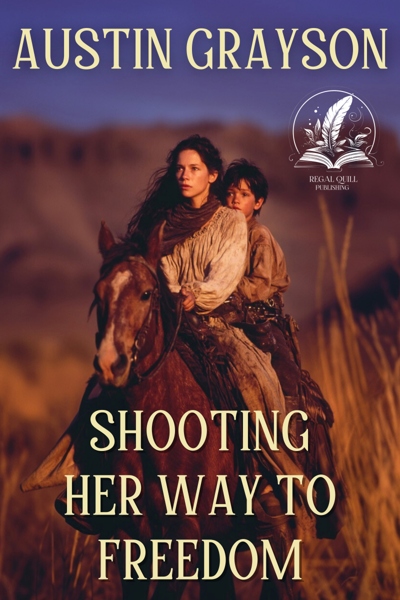
He nodded and set the lantern on a beam. Together they led the horses out, the gravel crunching under their boots. Clara swung onto her mare, wincing as the fresh bruise on her cheek pulled at her skin. Micah mounted behind her, his arms locking tight around her waist, head pressed between her shoulder blades.
She didn’t look back. Not at the house where Amos’s body still lay, not at the life she’d been forced to abandon. Instead, she fixed her eyes on the thin strip of road ahead, already lost in the shadows.
They rode in silence, two dark figures fleeing through the broken night. The wind carried with it the faintest whiff of gunpowder and blood, and Clara wondered if she’d ever be free of it, or if it would haunt her the rest of her days.
At the edge of the property, where the fence ended and the wild grass began, Micah finally spoke.
“Is Pa—” he started, then stopped.
Clara didn’t answer. There was nothing she could say that wouldn’t make it worse. So she pressed her heels to the mare’s flanks, felt the animal surge forward, and let the wind tear the rest of the questions away.
They didn’t stop riding until the sun had started to edge over the hills, painting the world in a sickly pink. Even then, they kept to the shadows, moving always forward, away from everything that had come before.
***
The Kansas Pacific Railway Station in Sullivan looked nothing like the grand depots built farther east, such as the one Clara had seen near Topeka. Here, the station was just a lean-to shed nailed together from wood scraps, perched at the edge of town. Continuous service by rail between Kansas City and Denver had only been in operation for four years, with the last spike driven in the line connecting the two cities in 1870.
A single lamp flickered above the ticket window, casting a dirty light over the battered planks and the cluster of figures hunched along the platform. Clara reined in the mare at the edge of the lot, her hands shaking so badly she nearly dropped the reins.
Micah slid off first, landing hard and staggering before regaining his balance. His eyes darted everywhere, counting faces, searching for threats or recognition. Clara watched him, measuring his fear against her own, and found them perfectly matched.
They left the horses tethered in the alley behind the smithy. It was a shame there was no time to sell them. They could surely use the money, but making their train was far more important. Clara shouldered their bags, moving fast but not so fast as to attract attention. She tugged her bonnet low, hoping to hide the swelling on her cheek, and prayed no one would look too closely at them.
They made it to the ticket window just as the bell sounded, announcing the final boarding. Steam filled the platform outside, and she heard the train’s engineer give two long blows of the whistle, announcing its imminent departure. Clara shoved two silver coins across the counter, hardly hearing the agent’s perfunctory words. She took the tickets, clamped Micah’s hand in her own, and hurried toward the line of waiting railroad coaches.
The engine hissed, black smoke from the firing engine curling into the sky. Conductors bustled up and down the train, slamming doors and waving lanterns. For a moment, Clara’s legs faltered, the world tilting under her feet. She wondered, absurdly, if someone had tipped them off, if Amos’s death had already rippled out and poisoned their chance at escape.
She bit down on the panic, pulled Micah closer, and they started to run.
Micah was faster; he always had been, all whipcord and nerves, built for slipping through cracks. He darted up the steps of the last passenger car, turned, and yelled back for her.
“Ma! Hurry!”
Clara’s lungs burned. Her legs were leaden, each stride harder than the last. She watched the conductor begin to swing the door shut, and for a heartbeat, she wanted nothing more than to stop, to sit down on the splintered platform and let the whole disaster roll over her.
She imagined the train pulling away, Micah inside, herself left behind to answer for all the violence she had unleashed into the world.
“Ma!” Micah’s voice was high and cracked, terrified.
She forced her legs to move. The edge of the platform rushed up at her. She nearly tripped, caught herself, and flung her bag onto the departing car. With a final, desperate lunge, she grabbed the rail and hauled herself onto the narrow metal step. Micah’s hands were on her arms, pulling, and together they tumbled into the dark, rattling belly of the train.
They landed hard, elbows and knees banged raw. For a moment, neither moved, breathless. Then Micah looked at her with a shock.
“We did it,” he whispered, as if afraid the words might jinx them.
Clara nodded. She ran her fingers through his hair, held him for a long minute, and listened as the world outside slipped away, replaced by the endless thrum and jostle of their chariot of escape.
The bench seats were cracked leather, slick with the sweat of a hundred previous passengers. Clara sat with her back to the window, Micah pressed in tight at her side, both of them hugging their bags to their chests.
The car was nearly full, a shuffling mix of miners, farmhands, and women with tired eyes and hands browned by sun and labor. Nobody paid them any mind.
For the first hour, neither Clara nor Micah spoke. The rhythm of the rails and the endless clatter of wheels on steel became a lullaby of sorts, numbing the rawness inside them. Clara watched the countryside slip by. Pastures gave way to forest, and towns vanished behind clouds of soot.
She tried to imagine what a new life would even look like. Her thoughts kept circling back to the blood under her nails, the way Amos’s body had felt as it went slack, how easy it was to end a man’s life, and how impossible it might be to undo what came after.
Micah broke the silence first. He kept his eyes on the window, his voice so soft that Clara almost missed it.
“Is Pa dead?” he asked.
Clara closed her eyes. There was no point in lying. “Yes,” she said, her voice barely more than a whisper. “He’s gone, baby.”
Micah was silent for a while, his breathing slow and careful. “Did you have to?”
She wanted to tell him no, that she wished it could have been different, that she was sorry for everything. Instead, she reached over and pulled him closer, letting him rest his head against her shoulder.
“Sometimes,” she said, “you do what you must to protect the people you love.”
He sniffed. “I loved him,” he said, the words small and strange.
“I know,” Clara answered. She rubbed his arm, wishing she could reach in and tear out the knot of hurt inside him. “I did too, once. But loving someone doesn’t mean you let them hurt you.”
He was quiet after that, but she could feel the tremble in his body, like he was holding in all the things he dared not say aloud.
When the conductor came through, Clara handed over their tickets. His eyes lingered on her bruised and swollen eye and then on the boy in her arms.
“Thank you kindly, sir,” she said.
“About to enter Colorado Territory, ma’am.” He tipped his hat with a look of polite worry and continued about his duty.
***
Sometime past noon, Micah asked, “Where are we going?”
“West,” Clara said. “As far as this train can take us. Then we’ll see.”
He nodded. “Will we ever come back?”
Clara shook her head. “No, Micah. We can’t. If anyone finds out what really happened…”
She let the threat hang in the air. The consequences were obvious, even to a child.
“You’d go to jail,” he said, not asking.
“Jail if I were lucky. They’d likely hang me. And you—” Her voice caught. “You’d go to an orphanage. Or worse, to the mines. Maybe even to your Uncle Silas. You know what he’s like.”
Micah shuddered. “I won’t let them,” he said. “I’ll run away before I let them.”
Clara squeezed his hand. “You won’t have to. We’re together, and that’s how it’ll stay. But you mustn’t ever tell, Micah. Not to anyone. This has to be our secret, forever. Do you understand?”
He looked at her, green eyes wide and solemn. “I promise, Ma. Cross my heart and hope to die.”
She kissed his forehead. For a long time, they just sat, letting the train rattle them into a new life.
Clara watched the fields and rivers slide by, wondering if she could ever outrun the shadow behind them. For Micah’s sake, she’d try.
***
By late day, the car had emptied out some, and Clara found herself sharing the bench with an older woman whose crinkled eyes and sun-spotted hands spoke of long years in the fields. Micah slept, curled up in Clara’s lap, his breath coming slow and regular.
For the first time in days, Clara felt the tension in her body ease, just a fraction.
The woman watched her for a while before speaking. “Your boy’s a handsome one,” she said, nodding at Micah’s mop of hair. “Smart, too, I reckon. He’s got that look.”
Clara managed a polite smile. “He’s a good son.”
The woman folded her hands over her knitting, needles clacking in a gentle rhythm. “Where you two headed, if you don’t mind me pryin’?”
“Utah,” Clara said. The first lie of many. She actually had no specific destination in mind as of yet. She could only afford tickets as far west as Denver. She glanced down at Micah, then back at the woman. “Got some family out in Salt Lake. Not much left for us back East.”
And so the lies pile on, one after another, she thought.
The woman nodded, as if she’d heard this story a hundred times. “It’s the same for most, I suppose. I was originally bound for Dry Creek. My great aunt and uncle settled there. Thought I’d find them old as the hills, stubborn as goats. You know the sort?”
Clara didn’t, but she nodded anyway.
“Well, it turns out that the two of them passed into the Lord’s hands last spring, God rest their souls, so now I’m off to Deer Trail instead. I’ve got cousins in Deer Trail.”
Clara nodded again politely.
The woman launched into a list of cousins and second cousins, uncles and assorted kin, half of whom seemed to work the same patch of earth and the other half who’d run off or vanished into the world. It was oddly comforting, the way she recited their names like a litany, as if the very act of remembering kept them alive.
When the train slowed at Deer Trail, the woman gathered her things and gave Clara a warm smile. “You hold onto that boy,” she said. “They grow up too quick. And watch yourself in Utah. It’s a strange place.”
Clara thanked her, watching as the woman stepped onto the platform and was swallowed by a small crowd. The train hissed, lurched, and rolled on.
She let Micah sleep a while longer while the contours of a plan formed in her mind. Her father had taught her that when one is making a getaway, the least direct route was always the best to help cover one’s trail.
She wanted to ensure that if questioned by marshals in search of a fleeing woman and her child, the kindly woman in Deer Trail or these conductors might not recall exactly when the pair left the train, but it was undoubtedly not Dry Creek.
Two stops past Deer Trail, Belmont, Colorado came into view. It was a scattering of clapboard buildings, a grain elevator, and the stark silhouette of a water tower. The station was little more than a shed. Clara was suddenly set on her plan of action.
She nudged Micah gently. “Wake up, honey,” she whispered.
He stirred, blinking, and when he saw the new town unfurling outside the window, his eyes filled with something that almost looked like hope.
They gathered their things. She waited until the train was nearly ready to depart, and then the two of them leaped onto the platform and began the next leg of their life-or-death escape.
***
The air in Belmont was thick with the dust of midsummer and the scent of livestock. The town was a jumble of low buildings, mostly wood, flaking paint, and hand-painted signs that leaned at precarious angles. The train platform emptied fast—nobody lingered in the heat—but Clara kept Micah close, her grip just shy of bruising.
They passed under the shaded overhang of the depot, bags thumping against their thighs, and Clara scanned the lane for the next stage out. A chalkboard propped by the ticket office window read, “Dry Creek—9:00 a.m.,” in blunt, sloping letters.
Clara steered Micah to the shade of the freight office, dropped their bags, and exhaled. Her nerves sang with exhaustion, but she forced herself upright and approached the ticket clerk inside. The man behind the counter was young, with wheat-blond hair and a face gone pink from sunburn. He looked them over briefly.
“Stage to Dry Creek?” Clara asked, sliding a couple of coins across the scarred wood. “We’re headed east to Chicago and thought we’d drop in on my aunt and uncle in Dry Creek on the way. Old as the hills and stubborn as goats. You know the sort, don’t you?”
He eyed the coins, then Clara. “Leaves from the stables just up the lane. You’ll want to be early. Only runs once a day, lady.”
Clara nodded, pocketed the tickets he handed her, and thanked him. She felt his gaze on her back as she walked out, but didn’t turn around.
They made their way to the livery, the sight of horses and the pungent aroma of manure oddly comforting after the confinement of the train. Micah perked up, watching the stable hands as they fed and brushed the big, patient draft animals. He lingered at the fence, reaching out to stroke the nose of a chestnut mare, and Clara let him, grateful for the first genuine smile she’d seen on him in weeks.
They found a quiet corner of the stage barn when no one was looking and cuddled up in the straw. Micah did most of the sleeping while Clara lay there awake, startled by every sound of the barn shifting with the wind or mice scurrying in the straw.
The next morning, when the appointed hour arrived, they were the only passengers waiting for the stage. The driver—a stoop-shouldered man in a battered hat—helped them load their bags, grunted for them to climb up, and within moments the stage lurched off the rutted street and out toward the open prairie.
Clara watched Belmont shrink behind them, every turn of the wheels drawing them farther from all that had gone before. The road unspooled ahead, shimmering in the heat. Beside her, Micah rested his head against her shoulder, eyes wide, and for the first time in a long while, Clara felt the air of possibility lift the weight of fear slightly from her heart.
They didn’t speak for a long time. There was nothing left to say that they didn’t already feel in their hearts.
Chapter Two
The first time Clara Whitlow stepped into Hattie Hale’s boarding house, the faint smell of lemon-oil polish and lavender greeted her. It was a smell reminiscent of safety and cleanliness. Three weeks later, those aromas were as fresh and as present as on their first day.
Clara had decided that as part of their plan of escape from Silas Crowder and the law, using her maiden name was a wiser course of action. It was their second full day in Dry Creek, and she told herself seemingly once an hour that if one whisper or sideways glance came her way, she would pack Micah up and whisk him to safety—in the middle of the night if need be.
Miss Hattie was a strong-willed widow who moved around her boarding house with purpose, like a field general commanding her troops. Her knowing eyes were beginning to cloud with age, but Clara still saw in them a kind soul.
A widow like Clara—although Hattie had likely not murdered her husband—the old woman seemed to know that Clara and Micah were doing their best to start over. In addition to running the boarding house, Hattie took on a host of mending and sewing jobs for the people of Dry Creek. Not a week into their stay, Hattie asked Clara if she had skill with a needle.
Playing her new role as bright-eyed, innocent young widow with a whip-smart boy to raise, Clara had replied, “Why yes, ma’am. I know every manner of stitch and hem. My mother taught me on Sundays after church.”
Of course, it was largely Clara who had taught herself out of necessity. She didn’t mention that her father had also taught her how to put a stitch in a man’s arm or forehead after a nasty fight in a saloon.
Despite the boarding house being peppered with guests, a small room on the second floor was given to Clara and Micah. A table by the window was offered as a workspace for her sewing, and a single sun-bleached curtain often billowed lightly as a draft snuck through the wooden frame.
The few coins Clara earned from her work manifested into an inexplicable satisfaction, much more consequential than the mere value of the currency. The work was demanding and at times monotonous, but every stitch seemed to do more good than simply repair fabric.
“I heard you mention, Mrs. Whitlow, that you attended church on Sundays as a child?” Hattie said one morning, upon dropping a new batch of mending jobs in their room.
“Yes, ma’am,” Clara said dutifully.
“Would you and the boy have any interest in attending services with me on Sundays?” Hattie said. “Might do that eternally gloomy spirit of yours some good to hear the good news that the Lord has proclaimed.”
Clara thought over the exposure to her and Micah that Sunday morning services would bring—half of Dry Creek would be sitting in those pews, if not more. Although it was not so much the threat of sitting among the townspeople as just another face in a sea of people in search of new lives in the Territory.
The looming threat that kept Clara awake most nights was the thought of Amos’s sadistic brother, Silas Crowder, catching up to them and seeking revenge. Even though she had managed to travel at least four hundred miles away from Silas, his desire for revenge would know no bounds.
“I wouldn’t want to impose…” Clara said.
“Nonsense, child. No imposition in the Lord’s house,” Hattie said, removing three torn shirts from a basket.
“And besides, Ruth Anne Willoughby, Margaret Bilcher, and I have made it our duty to enjoy coffee and biscuits after service and discuss the news of the week in Dry Creek.”
Clara’s muscles tightened.
“News? Is there news that travels all the way out here often from back East?”
“Oh goodness, no,” Hattie said. “I would describe our time together as not merely social but also highly… enlightening.”
Clara shot a look at Micah, dutifully working through a reading at the table at his mother’s insistence. Even the slightest hint that Hattie was onto them, she would scoop him into her arms, steal a mount from the livery, and they would be on to the next town.
“We discuss all manner of news. Which shopkeepers are bound to short you on a pound of flour. Who Sheriff McKenna arrested for being drunk as a skunk in the street on Friday night. Perhaps who might be sneaking off to Sam Rutledge’s meadow to do things they ought not be doing in the daylight.”
The old widow gave Clara a sly grin, giving her the understanding that these conversations might be more gossip than news by the trio of old souls.
Clara looked down at the basket and frowned. “Miss Hattie, this is half your week’s mending jobs.”
“My eyes are not what they used to be, child,” Hattie said.
“I can’t take your livelihood from you. You have to eat as well,” Clara said.
“As you can see, I am not starving,” Hattie said with a grin. “What the customers can’t pay you in coin, I will simply deduct from your week’s rent.”
“You are an angel,” Clara said.
While the words she chose were designed to keep up the guise of an innocent widow, Clara was truly touched by just how genuine Hattie’s affection and care had become in so short a time, for both Micah and her.
She wondered if Miss Hattie would be so sympathetic if she knew their real reason for attempting to start over in Dry Creek.
Chapter Three
Sheriff Asa McKenna thought Hattie Hale might be approaching seventy if she were a day, but she worked with the swift earnestness of a woman half that age or better. The new woman in town—Clara was her name, he had heard—was removing damp bedding and cloths from a basket, tending to the week’s wash.
Hattie was pinning the large items on a clothesline strung between the back corner of the boarding house and a thick, crooked elm twenty paces from the house as he rode up on his chestnut stallion. The sun blazed overhead, relentless in its summer fury.
As he got closer, he could see Clara’s auburn hair clinging to her temples, her skin prickling with sweat. The top three buttons of her olive floral dress were undone to allow her skin to breathe more easily under the toil of the afternoon chores.
The sheriff dismounted, looped the reins around a nearby fence, and removed his canteen from his saddle. Standing behind his horse for a moment, he straightened his vest over his shirt and made sure to wipe dust from his trousers before walking over to greet the two women.
“Afternoon, ladies. Can I offer you a sip of water? I retrieved it just this morning from Bitler’s Spring. As fine a water as any in a day’s ride,” Asa said.
Clara’s eyes darted over to him, squinting in the punishing wash of sunlight. She fastened a smile onto her face. “Oh, I’m fine, sir. Just a little too much heat, that’s all.”
Hattie clucked her tongue. “Come now, child. A sip of spring water will do your body well,” she said, not unkindly.
He pulled the cork from his US Army canteen and handed it to Clara. Her golden-green eyes, the color of new cottonwood leaves in spring, sparkled in the sun as she took the canteen. Their fingertips brushed—his callused, hers smooth despite the day’s labor.
She tilted her head back and took a long pull, her throat working as the cool water slid down. A single droplet escaped the corner of her mouth, trailing down the delicate curve of her neck before disappearing into the shadow between her collarbones.
Hattie raised her eyebrows and then pointedly glanced down at Clara’s dress, where the undone buttons revealed the cream-colored edge of her chemise and the gentle rise of her bosom with each breath. Asa blushed and looked away.
“The name is Asa McKenna. I’m the sheriff here in Dry Creek. I’m sorry I haven’t had the opportunity to introduce myself sooner.”
“Clara Whitlow. It’s a pleasure to make your acquaintance.”
Asa looked at Hattie and tipped his hat. She smiled and gave a knowing look in return, looking back at the tired young woman.
“Her grit reminds me of someone I knew long ago,” Hattie said.
Clara fought down the tremor of anxiety. She didn’t wish for any conversation to be about her, least of all one involving the sheriff. The words threatened to choke her, evoking a cascade of memories—the ones she wished to outrun.
“Was it someone from Dry Creek?” Clara asked, trying to steer the conversation away from her past.
“Nope,” Hattie replied, reaching up to pin a shirt to the line, the old muscles in her arms quivering under the strain. “She was from back East, same as you.”
Clara returned the canteen to Asa. “Lot of strong women back there, I suppose. Was she kin to you?”
Hattie gave a short, scratchy laugh. “No, not kin. She had more sense than most of my own blood, as it happens.” The line sagged as Hattie pinned up a quilt, hands moving fast and sure. “She was the kind of woman folks liked to gossip about, mostly on account of how she never let a man tell her much of anything. Folks said she was stubborn as a tired mule and smart as a snake in a henhouse, but I always thought the men just didn’t take kindly to being outfoxed.”
Hattie cocked her head, pinning Clara with a look that said she was measuring her up, weighing her words as well as the laundry in her basket.
Clara kept her eyes on the sheet she was smoothing over the line. “Sounds like folks out here aren’t much different. Folks will always talk.”
“Well, talk’s cheaper than salt in these parts, and worth about as much,” Hattie said, dusting her palms together before reaching for another shirt.
“Come now, Hattie. The folks of Dry Creek may chitter and chatter, but they’re twice as helpful as any in the Territory,” Asa said, kicking at long blades of grass under his feet. “I don’t want to leave you with the impression that the folks here are petty. By any measure, I find I’m in charge of a close-knit town that has each other’s backs.”
“Right you are, Sheriff,” Hattie said. “Now, did you come back here just to slow down my business of hanging the wash, or is there something official you were after?”
Asa turned and walked closer to Hattie so his questions were less easily overheard by the young woman. “Do you recall a Murdoch Blackedge staying with you about a month back?”
“Why, certain I do, Sheriff. I keep meticulous records,” Hattie said. “I haven’t seen him since the thirteenth of May. I happen to know that date because he never bothered to collect his things from his room. Left behind a saddlebag, a bedroll, fourteen dollars in coin, and three changes of clothes that aren’t fit for a drifter to wear.”
“I see. That date coincides with my investigation, Hattie,” Asa said, looking over at the young boy stacking stones into a fort in the grass. “Is he your boy?” he asked Clara.
“Oh, he sure is. He’s my pride and joy. My very reason for being,” Clara said.
“He’s a smart young man. Polite, too. Speaks volumes to the quality of his mother’s attention and her raising of him,” Hattie said.
Asa smiled. “And you’re certain it was the thirteenth of May that Murdoch disappeared?”
“Certain as a hot coal in a campfire. I am without remorse charging him ten cents a day storage fees until he returns for his items,” Hattie said.
“I do not believe Mr. Blackedge will be back to collect those things, Hattie.”
She frowned. “What’s become of the man?”
“It would seem that he found himself on the wrong side of a botched robbery,” Asa said. “Feel free to sell the items or keep them. The coin is yours to keep. On account of your trouble storing his goods for so long.”
“That’s mighty kind of you, Asa,” Hattie said.
The old woman did more than her fair share of helping him keep the town operating in an orderly fashion. She had a good eye for who to board and who to post the “no vacancy” sign to when such a measure helped keep the peace. Though he worried that she might overdo her duties in her advancing age.
Clara’s willowy frame caught his attention again, from the corner of his eye. She stretched up on her tiptoes to pin a faded pillowcase on the highest point of the line, the movement pulling her olive green dress taut across her shoulders and narrow waist.
As she reached higher, balancing precariously, the hem of her dress lifted, revealing first her ankles, then the gentle curve of her calves, pale as cream against the sun-dappled meadow grass that brushed against her bare feet. A whisper of breeze caught the loose tendrils of light auburn hair at her nape, dancing them across the exposed skin where her collar had fallen open again.
When he realized his gaze lingered for a second too long, he looked back at Hattie, who gave him a subtle wink. Blood rushed to Asa’s face, filling his cheeks with a redness that exposed his momentary lapse in propriety.
He tried to compose himself, but thoughts of Laura filled his mind. What would his late wife think of him admiring the form of this troubled widow, new to his town? He felt ashamed.
“I don’t mean to intrude a second longer, ladies,” Asa said. “I’ll be on my way.”
He gathered his canteen, tipped his hat one more time, then walked quickly, tripping twice on the grass as he made his way to his grazing mount, Flint. He pushed his polished spurred boot into the stirrup, lifted his muscular frame into the saddle of the coal-black stallion, then rode off to continue his latest investigation.
He rode faster than necessary, as if the brisk wind against his face might scour away the unbidden thoughts of the widow that now sat heavy as sin on his conscience.
***
Clara watched as the sheriff trotted off into the distance. She had concealed her glances at his striking features. He was tall, handsome, and had the air of a former military man. She knew the type, and once those habits were trained into a man, they were impossible for him to conceal.
It was in the way they walked, how they commanded their horse, and how they carried with them the scars of the things they were required to do out of duty to their country.
Hattie seemed eager to share all she knew about the strapping sheriff, just waiting for Clara to ask so she could unleash the man’s troubled story. Clara decided to give the woman the satisfaction of an opening question.
“So the sheriff… seems like you know him well?” she asked, still tending to the wash.
The words escaped Hattie’s lips like a bronco from a chute. “That man is a pillar of this community. It’s always the strong ones who the Lord chooses for difficult circumstances.”
“Something happened to him?” Clara inquired.
Hattie placed pins on two corners of a quilt, then answered. “Lost his wife to the fever two falls ago, and the poor soul just cannot give himself permission to move on.”
Clara was starting to wonder if the town should be renamed Widow’s Creek.
“But how he dotes on that little angel Lila is a sight to behold,” Hattie said.
“He’s a father?” Clara asked. She hung two more pillowcases on the line, sure to avoid eye contact with Hattie.
“Lila is the spitting image of her mother. The same age as your boy there, but try as he might, the man can’t seem to get that girl into a dress, sit properly in church, or use her manners. She spits in the dirt more than she says ‘please’ or ‘thank you,’ I’m afraid,” Hattie said. “He’s the all-business type and has his hands full running this town. He doesn’t seem to have the wherewithal to teach little Lila how to be a lady on top of his many other worries.”
OFFER: A BRAND NEW SERIES AND 2 FREEBIES FOR YOU!
Grab my new series, "Blood and Honor in the Wild West", and get 2 FREE novels as a gift! Have a look here!
Hi there, I hope you enjoyed this sneak peek of my latest story! I will be impatiently waiting for your comments below.